Fueling Innovation: Top 5 Government Schemes Empowering Indian Startups
Hello
My name is Gijo Vijayan, I am a Business coach, blogger, author and entrepreneur based at Bangalore, India.
I have many years of experience in corporate sector in Oil and Gas domain. Now I mentor startup companies all over the world. If you are interested to scale up your business, I can assist you with making strategies and solving real life problems.
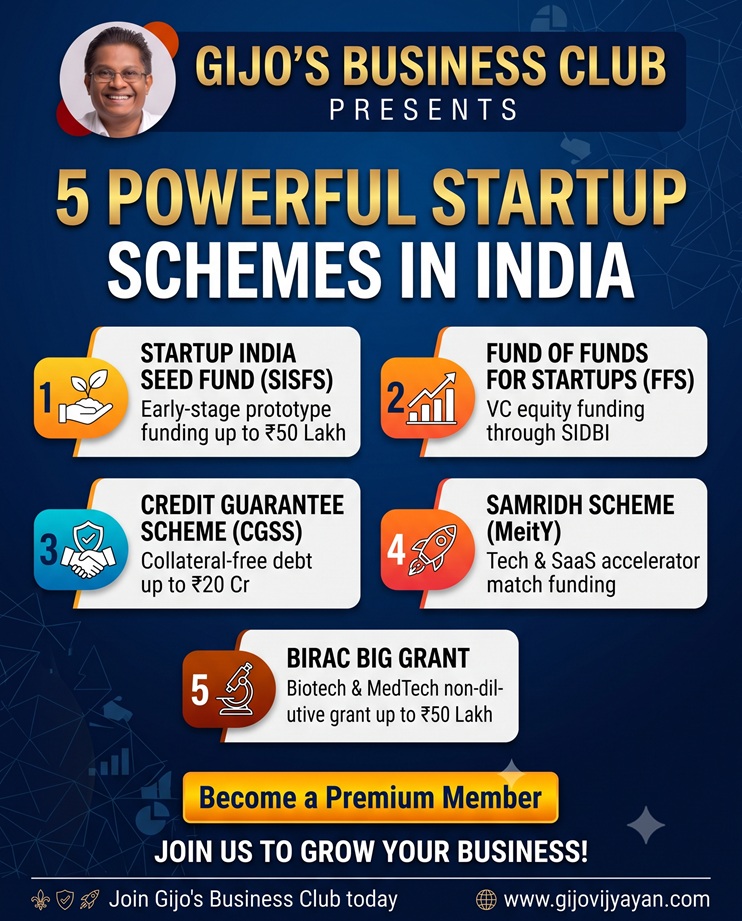
I am here to help startup companies grow their business. Here are top 5 Government Schemes Empowering Indian Startups.
India’s startup landscape is among the most dynamic globally, driven by relentless innovation and ambitious entrepreneurs. However, bridging the gap between an initial breakthrough idea and commercial viability remains a formidable challenge, particularly around capital access, intellectual property protection, and market entry.
To address these hurdles, the Government of India has launched structured initiatives that provide seed funding, equity participation, collateral-free credit, and accelerator support. Below is a detailed breakdown of five flagship startup schemes in India, outlining how each operates, who qualifies, and their core benefits.
### 1. Startup India Seed Fund Scheme (SISFS)
Early-stage validation is often termed the “valley of death” for startups: conventional venture capital firms prefer established traction, while bootstrapping can only go so far. The Department for Promotion of Industry and Internal Trade (DPIIT) introduced SISFS to fund founders at the proof-of-concept stage.
* **How It Operates:** The fund is not disbursed directly to startups from a central ministry. Instead, DPIIT allocates capital to approved business incubators across India, which then evaluate and disburse funds to eligible startups.
* **Financial Assistance:**
* Up to **₹20 Lakh** as a direct grant for proof of concept (PoC), prototype development, or field trials.
* Up to **₹50 Lakh** through convertible debentures, debt, or debt-linked instruments for commercialization, product launch, and market entry.
Eligibility: Must be a DPIIT-recognized startup incorporated within the last two years, with a viable business idea utilizing technology or innovation, and having received no more than ₹10 lakh in previous monetary support from other central or state government schemes.
2. Fund of Funds for Startups (FFS)
Rather than picking individual startup winners directly, the government established the Fund of Funds model, managed through the Small Industries Development Bank of India (SIDBI).
* **How It Operates:** SIDBI acts as a “mother fund,” committing capital to SEBI-registered Category I and II Alternative Investment Funds (AIFs)—commonly known as venture capital funds. These partner VC funds then invest downstream into high-growth, innovative Indian startups.
* **Core Advantage:** Startups receive institutional venture capital backed by government capital without dealing with bureaucratic red tape for individual investment rounds. It significantly expands the pool of domestic venture risk capital.
* **Eligibility:** Startups must qualify under DPIIT criteria, demonstrating scalable innovation and employment potential.
3. Credit Guarantee Scheme for Startups (CGSS)
Securing bank debt is notoriously difficult for asset-light startups, as traditional lenders mandate tangible physical collateral (such as real estate or machinery). CGSS solves this structural roadblock by providing sovereign credit guarantees to financial institutions.
* **How It Operates:** Managed by the National Credit Guarantee Trustee Company (NCGTC), the scheme covers collateral-free credit facilities (term loans, working capital limits, and venture debt) extended to eligible startups by scheduled commercial banks, NBFCs, and AIFs.
* **Coverage Scope:** Covers credit facilities up to **₹10 Crore to ₹20 Crore** per eligible borrower, absorbing a major portion of the default risk for lenders.
* **Eligibility:** The borrower must be a DPIIT-recognized entity with demonstrated commercial traction, stable audited financials, and no defaults on existing institutional facilities.
The **Startup Accelerators of MeitY for Product Innovation, Development and Growth (SAMRIDH)** is an initiative by the Ministry of Electronics and Information Technology (MeitY) targeted at software-as-a-service (SaaS), deep tech, and tech product startups.
* **How It Operates:** SAMRIDH partners with established startup accelerators. It matches capital with accelerator mentorship, customer discovery, go-to-market strategies, and investor networks.
* **Financial Assistance:** Offers up to **₹40 Lakh** in seed/growth funding per startup based on milestone achievements, alongside matching investment models where private accelerator capital is paired with government funding.
* **Eligibility:** Product-stage startups with an operational Minimum Viable Product (MVP) and proof of initial market validation in tech domains (FinTech, HealthTech, EdTech, AgriTech, Enterprise Tech).
5. BIRAC Biotechnology Ignition Grant (BIG)
Administered by the Biotechnology Industry Research Assistance Council (BIRAC), a Public Sector Enterprise under the Department of Biotechnology (DBT), BIG is India’s premier early-stage grant for life sciences and bio-entrepreneurs.
* **How It Operates:** Recognizing the long gestation periods and high lab infrastructure costs of biotech, BIRAC provides non-dilutive grant-in-aid to turn academic research or lab concepts into commercially viable technologies.
* **Financial Assistance:** Up to **₹50 Lakh** in pure grant-in-aid for up to 18 months, requiring zero equity dilution.
* **Eligibility:** Early-stage biotech startups (incorporated under 5 years) or individual researchers with a clear commercialization roadmap in healthcare, diagnostics, industrial biotech, medical devices, or agriculture.
### Key Action Step: Getting DPIIT Recognition
Most central schemes require formal recognition by DPIIT. To take advantage of these initiatives, founders should ensure their entity is registered as a Private Limited Company, LLP, or Registered Partnership, under 10 years old, with an annual turnover under ₹100 Crore. Applications can be completed online via the **Startup India Portal** (startupindia.gov.in) with basic incorporation documents and a clear note explaining innovation and scalability.
Join my WhatsApp Group:
Warm Regards
Gijo Vijayan
Business Coach
Bangalore
India
WhatsApp: +919798404042
Email: gijo@gijokv.com
#startup #mentoring #business #sales #marketing #businessclub