Prime Minister’s Employment Generation Programme (PMEGP): The Complete Guide for Aspiring Entrepreneurs, by Gijo Vijayan

Hello Readers
I am Gijo Viayan, startup mentor, Business coach and entrepreneur based at Bangalore.
I help startup startup companies to build their business and raise funds. I have expertise in strategy making and Online selling of products and services.
In this blog I will tell you , how to apply for Prime Minister’s Employment Generation Programme (PMEGP).
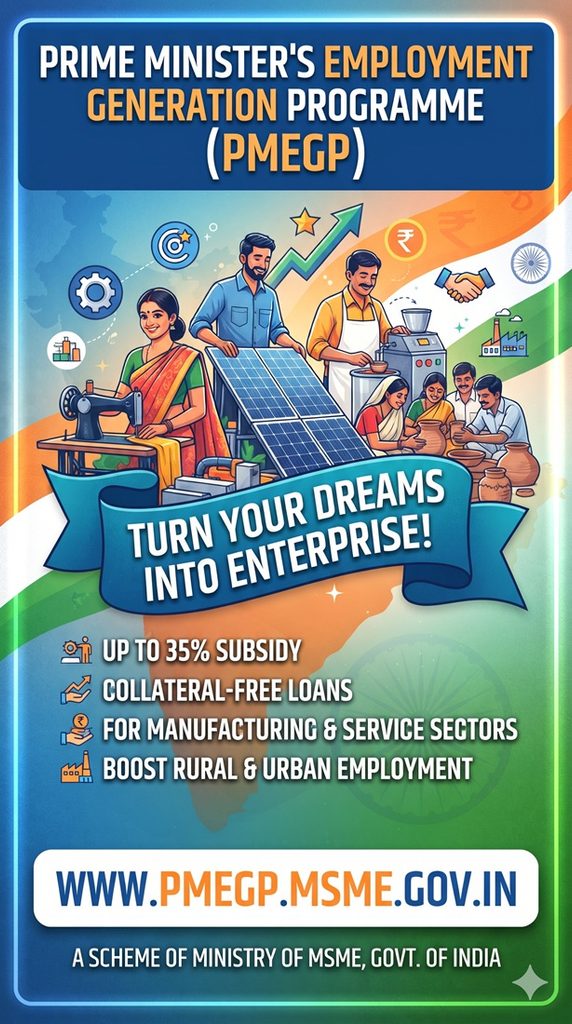
The Prime Minister’s Employment Generation Programme (PMEGP) is a Government of India credit-linked subsidy scheme administered by the Ministry of Micro, Small and Medium Enterprises (MoMSME) to help launch new non-farm micro-enterprises. Implemented nationally by the Khadi and Village Industries Commission (KVIC) along with State KVIBs, District Industries Centres (DICs), and participating banks, it combines government margin money subsidies with bank loans.
Turning a promising business idea into a reality often hits a single, stubborn roadblock: initial capital. While banks offer business loans, stringent collateral requirements and high upfront equity contributions frequently discourage first-time entrepreneurs, traditional artisans, and unemployed youth from taking the leap.
To bridge this gap, the Government of India introduced the Prime Minister’s Employment Generation Programme (PMEGP). Administered by the Ministry of Micro, Small and Medium Enterprises (MoMSME) and implemented at the national level by the Khadi and Village Industries Commission (KVIC), PMEGP is a flagship credit-linked subsidy scheme designed to generate sustainable self-employment across both rural and urban India.
Whether you are planning to launch a small manufacturing unit or a local service enterprise, this guide breaks down everything you need to know about PMEGP—from subsidy rates and eligibility criteria to the step-by-step application process.
What is PMEGP and How Does It Work?
Launched in 2008 by merging two earlier schemes—the Prime Minister’s Rozgar Yojana (PMRY) and the Rural Employment Generation Programme (REGP)—PMEGP supports the establishment of new micro-enterprises in the non-farm sector.
The core attraction of the scheme is its Margin Money Subsidy. Rather than forcing an entrepreneur to fund a large chunk of the project out of pocket, the government steps in to cover 15% to 35% of the total project cost. The entrepreneur contributes a nominal 5% to 10%, and a participating bank finances the remaining 60% to 80% as a term loan.
How the Subsidy is Adjusted: Once the bank sanctions and disburses the loan, the government’s Margin Money subsidy is deposited into a separate Term Deposit Receipt (TDR) in the beneficiary’s name at the lending bank for a lock-in period of 3 years. No interest is paid on this deposit, and no interest is charged on the corresponding portion of the loan. After 3 years—subject to successful physical verification confirming the business is active and operational—the subsidy is permanently adjusted against the borrower’s loan principal.
Maximum Project Cost & Subsidy Structure
The financial limits under PMEGP depend on whether you are starting a new enterprise or upgrading an existing, successful PMEGP/MUDRA unit, as well as your sector.
- Project Cost Ceilings (For Subsidy Calculation)
| Enterprise Type | Manufacturing Sector | Business / Service Sector |
| Setting Up a New Unit | Up to ₹50 Lakh | Up to ₹20 Lakh |
| 2nd Loan for Upgradation (Existing successful units) | Up to ₹1 Crore | Up to ₹25 Lakh |
Note: If your total project cost exceeds these ceilings, you can still apply—banks can finance the remaining balance, though the government subsidy will only be calculated up to the maximum limits listed above.
- Margin Money Subsidy & Beneficiary Contribution
The exact subsidy percentage depends on your social category and the geographical location of your unit:
| Beneficiary Category | Own Contribution | Urban Area Subsidy | Rural Area Subsidy |
| General Category | 10% of project cost | 15% | 25% |
| Special Categories (Women, SC, ST, OBC, Minorities, Differently-Abled, Ex-Servicemen, Transgender persons, NER, Hill/Border & Aspirational districts) | 5% of project cost | 25% | 35% |
Example in Action:** Suppose a woman entrepreneur sets up a rural food-processing (manufacturing) unit with a total project cost of ₹10,00,000.
Her Own Contribution (5%):** ₹50,000
Government Margin Money Subsidy (35%):** ₹3,50,000
Bank Term Loan (60%):** ₹6,00,000
(For second-loan upgradation of existing successful units, the subsidy rate is fixed at 15% across all categories, and 20% for the North Eastern Region and Hill States.)*
Who is Eligible to Apply?
PMEGP keeps entry barriers intentionally low to encourage grassroots entrepreneurship:
Age:** Any Indian citizen aged 18 years or above. There is no upper age limit.
Income Ceiling:** There is no income ceiling for setting up a project under PMEGP.
Educational Qualification:** No minimum educational qualification is required for smaller projects. However, you must be at least Class VIII (8th standard) pass if your project cost exceeds ₹10 Lakh in the manufacturing sector or ₹5 Lakh in the business/service sector.
New Units Only:** Assistance under the first loan is strictly meant for new greenfield ventures. Existing operational businesses or units that have already availed subsidies under other central/state schemes are ineligible.
One Per Family:** Only one person from a single family (defined as self and spouse) can avail financial assistance under the scheme.
Eligible Entities:** Alongside individuals, Self-Help Groups (SHGs), institutions registered under the Societies Registration Act 1860, Production Co-operative Societies, and Charitable Trusts are also eligible.
What Activities Are Excluded?
While almost all viable non-farm manufacturing and service businesses are covered, PMEGP maintains a Negative List. Prohibited activities include:
- Businesses involving meat/slaughterhouses, intoxicants (liquor, bidi, pan, cigarettes), and cultivation of crops/plantations.
- Manufacture of polythene carry bags (below prescribed thickness) or environmentally hazardous products.
- Pure trading/retail outlets (except in notified North Eastern states, Left-Wing Extremism-affected districts, and Andaman & Nicobar Islands).
Key Features & Loan Terms
Collateral-Free Loans:** Loans up to ₹10 Lakh are collateral-free as per RBI guidelines. For loans above ₹10 Lakh (up to ₹50 Lakh), banks can cover the credit risk under the Credit Guarantee Fund Trust for Micro and Small Enterprises (CGTMSE), sparing entrepreneurs from pledging personal property.
Interest Rates & Repayment:** Banks charge standard base/MCLR-linked MSME interest rates (typically ranging between 10% and 12% per annum, depending on the bank and credit profile). Repayment tenure generally spans 3 to 7 years, including an initial moratorium period.
Mandatory EDP Training:** To equip first-time founders with basic business management, accounting, and marketing skills, completing an Entrepreneurship Development Programme (EDP)** is mandatory before the subsidy is released. Training lasts 5 working days for projects up to ₹5 Lakh and 10 working days for projects above ₹5 Lakh (exempted for projects up to ₹2 Lakh or if the applicant has already completed recognized skill/EDP training).
Documents Required for Application
Before starting your online application, keep scanned copies of the following documents ready:
- Identity & Address Proof:** Aadhaar Card (mandatory for demographic authentication) and PAN Card.
- Photograph:** Recent passport-size photograph.
- Detailed Project Report (DPR):** A comprehensive business plan outlining machinery/equipment costs, working capital needs, raw materials, marketing strategy, and financial projections. (Sample DPR templates are available directly on the KVIC portal.)
- Educational Qualification Certificate:** Class 8th pass certificate or higher (mandatory for projects above ₹10 Lakh in manufacturing or ₹5 Lakh in services).
- Social / Special Category Certificate:** Caste certificate (SC/ST/OBC) or relevant proof for minorities, ex-servicemen, or differently-abled applicants, if claiming higher subsidy rates.
- Rural Area Certificate:** Issued by the local revenue authority (Tehsildar/BDO/Gram Panchayat) if your unit is located in a rural area, to qualify for the 25%–35% subsidy tier.
- Quotations & Registration:** Machinery/equipment quotations and entity registration documents (for SHGs, societies, or trusts).
Step-by-Step Guide to Applying Online
The entire PMEGP application process is digitized and transparent through the official portal:
- Visit the Official Portal:** Go to the KVIC PMEGP e-Portal and select Application for New Unit”**.
- Fill Out the Application Form:** Enter your Aadhaar details, personal information, chosen Implementing Agency (KVIC, KVIB, DIC, or Coir Board**), proposed business activity, project cost breakdown, and preferred financing bank branch.
- Upload Documents:** Upload your photograph, DPR, and supporting certificates, then submit the form to generate your unique **Application ID.
- Agency Scrutiny:** The selected Implementing Agency (KVIC/KVIB/DIC) reviews your application and project viability before forwarding it to your chosen bank.
- Bank Appraisal & Sanction:** The bank conducts an independent technical and financial appraisal. Once satisfied with the project’s viability, the bank issues a loan sanction letter.
- Complete EDP Training & Disbursement:** Complete the mandatory online or offline EDP training. Submit the EDP certificate and deposit your own contribution (5% or 10%) with the bank. The bank then disburses the loan and claims the Margin Money subsidy from KVIC.
Tips to Maximize Your Approval Chances
Craft a Realistic DPR: Banks reject applications most often due to inflated projections or vague cost estimates. Back your machinery and raw material costs with genuine vendor quotations.
Choose the Right Bank Branch:** Select a bank branch located close to your proposed business site—local branches can inspect your premises faster and are more familiar with local market demand.
Keep Your Credit Score Clean: Even though PMEGP is a government-backed scheme, banks still check CIBIL scores. Ensure you have no past loan defaults before applying.
Verify Rural Classification Early:** Many entrepreneurs assume their town is “rural” only to find it falls under municipal limits. Obtain a formal Rural Area Certificate beforehand if you are counting on the 25% or 35% subsidy slab.
With up to ₹50 Lakh in project support and as much as 35% of the cost covered by the government, PMEGP remains one of India’s strongest launchpads for turning self-employment ambitions into sustainable businesses.
The entire PMEGP application is processed online through the official KVIC PMEGP e-Portal (kviconline.gov.in/pmegpeportal or pmegp.msme.gov.in). You do not need to pay any application fee or go through middlemen.
Before You Start: Prepare Scanned Documents
Keep clear scanned copies (typically under 1 MB each) of the following ready before opening the portal:
Aadhaar Card & PAN Card** (ensure your mobile number is linked to Aadhaar for OTP verification)
Recent passport-size photograph**
Detailed Project Report (DPR)** outlining machinery costs, working capital, and revenue projections (sample DPRs are available on the portal)
Highest Educational Qualification Certificate** (mandatory Class 8th pass certificate if project cost exceeds ₹10 Lakh in manufacturing or ₹5 Lakh in services)
Social / Special Category Certificate** (SC/ST/OBC/Minority/Ex-Servicemen/Differently-Abled), if claiming higher subsidy
Rural Area Certificate** issued by the local revenue authority (Tehsildar/BDO/Gram Panchayat), if your unit is in a rural area
Step-by-Step Online Application Process
- Access the Official PMEGP e-Portal:** Use only official .gov.in portals.
Visit the KVIC PMEGP portal at kviconline.gov.in/pmegpeportal (or pmegp.msme.gov.in). Click on “Application for New Unit” (or “Application for Existing Units (2nd Loan)” if you are upgrading an existing successful PMEGP/MUDRA unit). - Complete Aadhaar Authentication & Personal Details:** Active Aadhaar-linked mobile number required.
Enter your 12-digit Aadhaar number and PAN, give consent for demographic authentication, and verify via the OTP sent to your registered mobile number. Fill in your name (matching Aadhaar), date of birth, social/special category, educational qualification, and communication address. - Select Your Implementing Agency & Unit Location:**
Choose your proposed unit’s address and specify whether it falls under a Rural or Urban area. Select one of the implementing agencies from the dropdown—KVIC, KVIB, DIC (District Industries Centre), or Coir Board—to scrutinize your application. - Enter Project Cost & Select Financing Bank:** Working capital caps: max 40% (manufacturing) or 60% (services).
Choose your activity type (Manufacturing or Service), select the relevant NIC Code for your business, and enter your Capital Expenditure and Working Capital breakdown along with projected employment generation. Select your preferred Primary Financing Bank and branch (ideally close to your business location). Click “Save Applicant Data”. - Upload Documents & Complete the Score Card:**
Upload all required scanned documents (photo, DPR, caste/rural/education certificates). Next, click on the “Score Card” tab, answer the self-assessment questions regarding project viability and readiness, and click “Save”. - Final Submission & Credential Generation:
Review the entire application preview carefully, accept the declaration, and click Final Submit. Your unique Application ID and Password will be sent via SMS to your registered mobile number. Save these credentials to log in anytime under “Registered Applicant Login” and track your real-time application status.
What Happens After You Submit?
- Agency Verification (1–2 Weeks): The chosen agency (KVIC/KVIB/DIC) reviews your application and DPR, and forwards viable proposals to your selected bank branch.
- Bank Appraisal & Sanction (30–60 Days): The bank manager conducts a site visit and financial appraisal. Once approved, the bank issues a Sanction Letter. (Tip: Visit your chosen bank branch with a printed copy of your submitted form and DPR a few days after agency forwarding to speed up processing.)
- EDP Training & Own Contribution: Complete the mandatory online or offline Entrepreneurship Development Programme (EDP) (5 to 10 days depending on project size) and deposit your 5% or 10% own contribution in the bank.
- Loan Disbursement & Subsidy Claim: Once you submit your EDP certificate, the bank releases the loan in installments and claims the 15%–35% Margin Money subsidy directly from KVIC.

I have created “Gijo’s Startup Business Club” to help entrepreneurs and startup companies to grow and prosper.
If interested to become a PREMIUM MEMBER of “Gijo’s Startup Business Club”, kindly contact me.
Warm Regards
Gijo Vijayan
Business Coach
Bangalore, India
WhatsApp: +919798404042
Email: gijo@gijokv.com
www.GijoKV.com
Instagram:
Book appointment with Gijo Vijayan
#startup #mentoring #business #sales #marketing #businessclub #mudraloan #loan #centralgovernment #pmegp